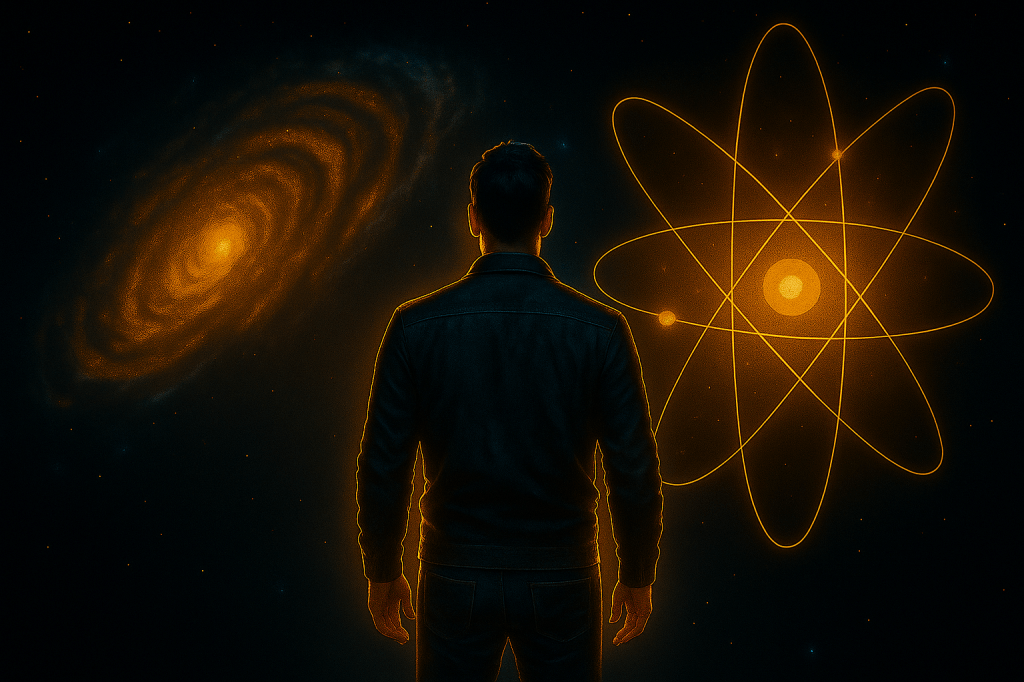
Imagine, a scale so vast it stretches from the outermost edge of the observable universe to the hidden interior of a single atom. On one end lies the immensity of existence: galaxies beyond counting, swirling across endless darkness, each one a monument of fire and gravity, separated by oceans of silence and time. On the other end lies a realm so minuscule, so elusive, that the very language we use begins to fray, it is the world of subatomic particles, where the classical rules dissolve and reality behaves like a flickering mirage of probability and potential.
And in the vast, trembling middle of this cosmic span stands man.1
Not the largest being, nor the smallest. Not the most durable, nor the most powerful. And yet, man is the only known entity capable of holding both infinities in a single thought. He gazes upward and wonders what lies beyond the furthest star. He peers inward and marvels at the unseen forces that govern the tiniest constituents of his body. In this dual act of witnessing — one stretching toward the heavens, the other collapsing inward — man fulfills a profound and ancient prophecy, one etched in revelation of Qur’an: “We will show them Our signs in the horizons and in themselves until it becomes clear to them that it is the truth.” 2
This verse, drawn from the Qur’an, is not simply poetic. It is an ontological map. The “horizons” speak of the macrocosm — the stars, galaxies, and gravitational dances played out over billions of years. “Themselves” speaks of the microcosm — the self, the cell, the circuitry of neurons, and the silent language of DNA. Both ends of the spectrum are ayat (signs) waiting to be seen, waiting to be understood. And man is the intended witness.
With instruments of glass and mathematics, we have reached outward to photograph galaxies being born, to listen to the gravitational echoes of colliding black holes, and to measure the temperature of a universe still glowing from its creation. We have stretched our hands toward the stars and found them intelligible. At the same time, we have turned inward, unlocking the hidden architecture of the atom, decoding the instructions of life in our cell, splitting particles and opening gateways into into the invisible web of particles and forces that compose all we see and are. In both journeys, outward and inward, we have not only discovered facts but we have discovered wonder. And that wonder itself becomes an ayah (sign).
Man does not merely observe these realms. He interprets them. He names them. He gives them meaning. A nebula, in its grandeur, would still exist without human eyes, but it would be mute, colorless, purposeless, and forgotten. An electron might spin, but its motion would be lost in the void unless someone asked, “Why?” It is through human consciousness that these phenomena are not only registered but elevated. Man becomes the bearer of significance in a world that would otherwise remain silent.
To exist between the galaxies and the quarks is to live in a sacred tension, one that pulls him upward toward majesty and downward toward mystery. He is composed of dust, but dust arranged with the capacity to wonder. He is born of the earth, but wired to contemplate the heavens. In this, he does not merely fill a gap in the chain of being; he becomes its interpreter. He sees the ayat (signs) — in the skies, and in the self — and in reading them, he finds his place.
When the Qur’an declares that these ayat (signs) will be shown in the horizons and within ourselves, it is not speaking only of prophecy or metaphor. It is describing the very structure of reality, where every layer of existence, from the spinning galaxy to the spiraling helix, is crafted with intention and infused with meaning. And yet that meaning does not bloom until man sees it. The stars wait to be named. The atoms wait to be understood. The soul waits to be awakened.
Without man, the universe remains unread. Without his heart, the signs remain untranslated. The cosmos may unfold with mathematical precision, but it is man who asks, “What does it mean?” In this way, he becomes the bridge, the translator, the one through whom creation begins to know itself.
We often imagine ourselves as insignificant, a fragile presence on a pale blue dot, but in the realm of meaning, we are central. Not because we created the universe, but because we are the ones through whom the ayat (signs) of the Creator are revealed. The galaxies are majestic, the particles profound, but their majesty and profundity reach fulfillment only when they are witnessed, contemplated, and understood.
Man is not merely in the middle. He is the mirror. Through him, the cosmos reflects its own truth.
Footnotes:
- The term “man” here is used in its classical, universal sense to mean humanity as a whole, encompassing all human beings regardless of gender. It reflects a philosophical and literary tradition where “man” symbolizes the human condition, consciousness, and the capacity for reflection. ↩︎
- Qur’an, Surah (chapter) 41: Verse 53 ↩︎
 Yasir Abbas
Leave a comment