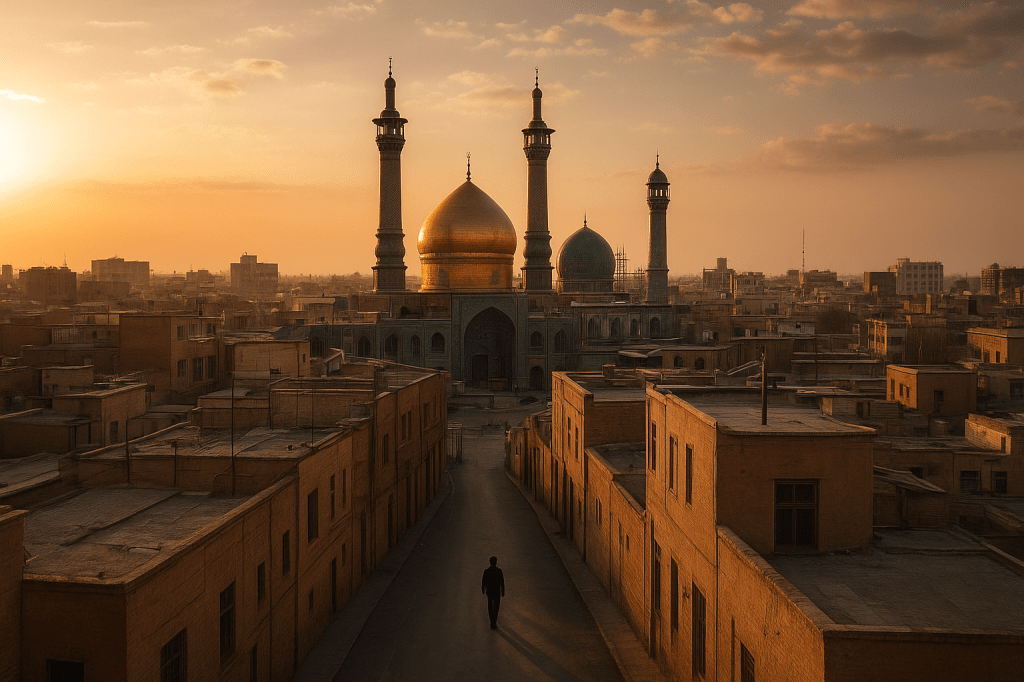
It had been over sixteen years since I last walked these streets. The moment I set foot in Qom again, a wave of memory rose like a tide and broke within me. The city felt both familiar and foreign. I recognized it, yet it no longer recognized me. The narrow alleys I once knew had stretched wider, polished and impersonal, lined with unfamiliar buildings that stood like silent sentinels, indifferent to the footsteps of those who return. Beneath the surface of this physical transformation, it was the inner world that had changed most is the rhythm of the students’ lives, the pulse of the seminary.
Where once burned a shared fervor for study, debate, and spiritual discipline, I now sensed scattered priorities, competing distractions, and a new comfort that has quietly reshaped the way students live, learn, and carry the weight of their calling. This journey of observation became more than nostalgia. It became a meditation on time, on change, and on how the forces of society and technology are subtly rewriting the soul of Qom’s seminary life.
The Seminary and Its Purpose
In Shia thought, the ulama — the scholars and teachers — are not just intellectuals but guardians of a living heritage. They stand at the intersection of thought and faith, preserving, interpreting, and transmitting the light of the Ahl al-Bayt (peace be upon them). Their task is both intellectual and moral: to clarify divine law, guide communities, and embody the spirit of justice and truth.
Through teaching, writing, and debate, they ensure that Shia thought continues to evolve without losing its core. The seminarians, those who walk the corridors of Qom in humble pursuit of knowledge, are the next link in that unbroken chain. Their years of study are not just about mastering jurisprudence or theology, but about shaping the self into a vessel of guidance and sincerity.
Most graduates of the seminary take one of two main paths. Some return as resident scholars, leading prayers, teaching, and offering daily guidance to their communities. Others become preachers and speakers, carrying the message of Islam through majalis and lectures to wider audiences. There are also those who serve as writers, translators, or educators in institutes and madrasas. And now, in this digital age, there are tech-integrated preachers who use videos, podcasts, and social media to carry divine messages into the virtual realm.
For many, entering the seminary is a spiritual or intellectual calling. Some come to seek closeness to God, others for the pursuit of knowledge, or to reshape themselves through discipline and devotion. For a few, it is a family tradition or cultural expectation. For some, it is an escape from the world’s chaos, a journey inward.
The Way It Was
In my time, students’ priorities could be traced into three clear streams. Some studied diligently, hoping to return home as resident scholars or speakers. Others immersed themselves in research and debate, seeking mastery over texts and reason. And there were those like me, drawn to Qom not to wear a turban, but to taste the sacred, to be transformed, to return not as an alim but as a better soul.
The Way It Is Now
Today, I see something different. Priorities have scattered. I do not judge, but I cannot ignore what I observe. In my days, there was a certain alignment of purpose; students formed circles of mutual accountability and shared growth. Today, they are more individualistic, influenced by global ideologies, diverse mentors, and digital communities. The seminary has become porous, connected to the world in ways that both enrich and unsettle it.
Western-educated students, global funding, and social media now shape seminarian thought. What was once a cloister of focused discipline is now an ecosystem influenced by distant algorithms and diasporic expectations. Students must navigate complex external pressures alongside their spiritual formation, and while many rise to the challenge, some lose direction amid the noise.
Qom itself has changed in its streets, skyline, and rhythm. Students now live more comfortably than we ever did. Comfort is not a sin, yet it is a subtle test. It eases hardship but can also dull resolve, softening the edge of struggle that once refined the soul. Discipline, hunger, and restraint, once hallmarks of seminary life, risk being replaced by convenience, social media validation, and quiet self-satisfaction. The tendencies I see among English-speaking students—burnout, ego, ideological drift, retreat into comfort—are faint symptoms of something deeper.
It is important to note that most students I met remain sincere and focused, deeply committed to their studies and service. What I describe here are subtle shifts in the atmosphere and a few particular cases that stood out in my conversations and observations. These exceptions do not define the seminary, but they illuminate the new challenges that may, if unaddressed, grow silently within it.
The Weight of Comfort and the Shadows of Distraction
During my visit, I met old friends, a few still studying after twenty years. Among those who stay long, some do so for legitimate reasons: for their children are in school, their research is incomplete, or their obligations keep them rooted. Yet there are others who remain not out of purpose but habit. The seminary, for them, becomes a cocoon of comfort. When the goal is no longer ijtihad, what then justifies two decades of study? Ten years of sincere effort can equip one to serve. Beyond that, one must question if the journey has become an escape rather than a pursuit.
I spoke with new students, English-speaking and Indian alike. Their honesty was disarming. Some of my contemporaries who once shone with promise had been confined by circumstance, personal, institutional, or emotional, to smaller roles. Others were sidetracked by forces beyond their control. Without naming anyone, I wish to draw lessons from their stories, for each failure contains a warning for the next generation.
I recall a young seminary, once aflame with passion, whose speeches stirred hearts. Marriage came, and with it a withdrawal to different city in north of Iran, focusing on Qur’anic Sciences & Commentary. Perhaps it was sincerity, perhaps exhaustion. Maybe I was wrong to conclude yet I thought it was the slow sleep of the soul. A good wife, perhaps unknowingly, urged him toward peace: “Avoid controversy, focus on Qur’an, do not invite enemies.” Affection tamed his restlessness. Not through malice, but through love, the lion became domesticated.
Another case reached my ears, of a scholar of great intellect, undone by a storm of public opinion. An old, edited clip resurfaced, his words taken out of context, and outrage spread like wildfire. The same mentors who once praised him advised silence and retreat. Feeling betrayed, he lashed out, and the crisis turned inward. Some say it was manipulation, others say it was the test of the heart. But I saw in his story a reflection of every soul that speaks truth will always face distortion, and even friends will go silent, sometimes from fear and sometimes from strategy.
From such stories I drew reminders for myself, and for those who seek to serve through knowledge:
- Speak for God, not for applause. When the heart seeks validation, sincerity fades.
- Expect betrayal; it is part of the path. Prophets (a) too were forsaken by their people.
- Transform isolation into intimacy with the Divine. What feels like exile can become the highest form of nearness if one remains sincere.
Between Concern and Hope
Qom today still vibrates with life. Its light has not dimmed, though its colors appear to have changed. Students fill the courtyards, the libraries are alive with voices, the sound of Quran recitation still rises at dawn. The soil remains sacred, the air still holds that scent of unseen grace. Yet the balance between comfort and calling feels fragile.
Most of the students I met are better equipped, more articulate, and often more globally aware than my generation ever was. They are the future, and many carry hearts of light. But the tests that face them are quieter, less about hunger and more about distraction, less about endurance and more about consistency. The challenge now lies in preserving the fire amid comfort, focus amid distraction, sincerity amid visibility.
Qom has always been a cradle of both intellect and spirit. The tradition will endure, as it always has, through those who carry its weight with humility. The danger is not corruption but dilution, not deviation but complacency. Yet even as I write this, I remind myself that Qom’s strength lies in renewal. For every student who drifts, there are many who rise, clear-eyed and determined.
Closing Reflections
On my last day I walked toward the shrine of Bibi Masuma (peace be upon her). The call to Fajr prayer echoed softly through the air, mingling with the murmurs of pilgrims. The light that shone from the dome seemed the same as when I was still young, unwavering, eternal. The city may evolve, its face may change, but its heart remains the same.
Qom does not promise comfort. It promises confrontation with the self. Those who come here seeking God must learn to lose themselves before they find what they came for. Time changes, students change, but the sacred call remains unchanged: to live for truth, to serve without vanity, and to seek knowledge that illuminates the soul.
When I left, I carried with me both gratitude and longing. Gratitude for what Qom had given me, and longing for what I once was within its embrace. Perhaps that is what every return truly is: not a journey through space, but a return to the mirror of one’s own beginning.
 Yasir Abbas
Leave a comment